

The Weekly Wealth Watch
November 23, 2026
The Markets
“Don’t focus on making money; focus on protecting what you have.” — Paul Tudor Jones, Founder & CIO, Tudor Investment Corporation.
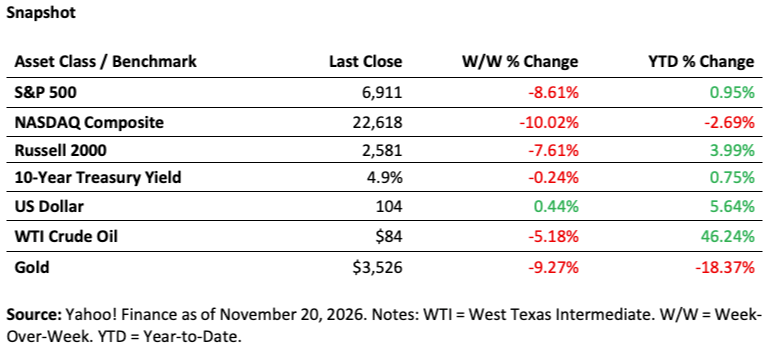
U.S. equities moved sharply lower for the week. The S&P 500 declined 8.61%, finishing at 6,911, while the NASDAQ Composite declined 10.02% to 22,618. The Russell 2000 declined 7.61% to 2,581. Year-to-date, the S&P 500 and Russell 2000 remain positive, while the NASDAQ is now down 2.69%.
The 10-Year Treasury yield declined 0.24%, finishing the week at 4.9%. The U.S. Dollar gained 0.44% to 104, extending its year-to-date gain to 5.64%.
Commodities also faced significant pressure. WTI crude oil declined 5.18%, finishing at $84 per barrel, although it remains up 46.24% year-to-date. Gold declined 9.27% to $3,526, extending its year-to-date decline to 18.37%.
Overall, it was a difficult week across markets, with substantial declines in equities, oil, and gold. Treasury yields moved lower while the dollar strengthened.
Paul Tudor Jones is known for emphasizing risk control and capital preservation. During weeks when market volatility rises sharply, his philosophy offers a timely reminder: successful investing isn’t only about participating in upside—it’s also about understanding and managing downside risk.
Boring Is Beautiful
“The essence of investment management is the management of risks, not the management of returns.” — Benjamin Graham
Financial headlines naturally gravitate toward excitement—the biggest companies, fastest growers, and stocks with the strongest momentum.
But the Weekly Input reminds us that sometimes boring can be beautiful.
“Boring” companies may not have massive margins or the highest earnings growth rates. What they may offer instead are durable businesses, strong cash generation, dividends, and more stable trends.
Some also possess an economic moat—a competitive advantage that can make their business difficult to challenge.
And when markets become volatile, these less exciting characteristics can suddenly become much more interesting.
When Boring Behaves Differently
One way to understand these companies are through beta, which measures an investment’s historical sensitivity to movements in a benchmark.
A stock with lower beta may not rise as much when the market surges.
But it also may not decline as much when the market falls.
There is a trade-off.
A portfolio filled entirely with lower-beta investments could struggle to keep pace during strong markets. Academic research has explored adding leverage to lower-beta portfolios to increase market exposure, but leverage introduces another problem: it can magnify losses as well as gains.
The lesson is simple:
Lower sensitivity to the market doesn’t mean no risk.
That’s why the Weekly Input goes beyond beta.
It’s About How the Pieces Fit Together
Another important consideration is correlation—how closely investments move together.
A company can actually have high volatility but relatively low beta because its returns are not highly correlated with the broader market.
That difference can be useful.
When investments behave differently, they may provide diversification benefits within a larger portfolio.
Position sizing matters too.
Rather than filling a portfolio with low-beta stocks, an investor can potentially use them alongside investments that behave very differently.
The goal isn’t to make every investment act the same.
It’s to understand how the pieces work together.
A traditional hedge might involve a short position or put option designed to benefit when another investment falls.
Diversification is different.
A long-only portfolio may sometimes contain investments that rise while others decline because of market rotation, crowding, or different investor behavior.
That relationship isn’t guaranteed. Correlations can change, especially during periods of market stress.
But when volatility rises, less-correlated or less-volatile areas of the market can sometimes become more attractive.
That helps explain Jim’s conclusion:
“We continue to love boring stocks that behave differently than other stocks, especially when markets are volatile.”
Boring isn’t necessarily about finding stocks that never decline.
It’s about finding investments that may perform a different job.
Human Interest: The Backup Quarterback
Nobody buys a ticket hoping to watch the backup quarterback.
The starter gets the headlines and highlights reels.
But when conditions change, the person quietly waiting on the sideline can suddenly become very important.
Some investments can play a similar role. They may not lead during every strong market, but when volatility increases, owning investments that behave differently can become valuable.
Fun Facts & Figures
🥱 Boring Can Have a Moat: Less exciting companies may still possess durable competitive advantages, generate cash, and pay dividends.
📉 Beta: Measures an investment’s historical sensitivity to a benchmark. A beta below 1 means lower historical sensitivity—not necessarily lower total risk.
🔗 Correlation: Measures how closely two investments move together and ranges from –1 to +1.
🧺 Diversification: Spreading investments across different exposures can help manage portfolio risk, but it cannot eliminate risk.
⚖️ Leverage: Increasing investment exposure through borrowing or financial instruments can magnify both gains and losses.
Bottom Line
Exciting investments naturally attract attention.
But a portfolio doesn’t have to be exciting everywhere.
Companies with durable businesses, stable trends, lower market sensitivity, or different correlations may contribute something equally important: balance.
They won’t always outperform, and they aren’t guaranteed protection during market declines.
But when markets become volatile, sometimes the investments nobody wanted to talk about become the ones worth talking about.
Sometimes boring really is beautiful.
On This Day in History — November 23
🎵 1889 — The Jukebox Arrives
On November 23, 1889, an early coin-operated phonograph was installed at the Palais Royal Saloon in San Francisco.
Put in a coin, listen to music.
Simple. Useful. And hardly flashy by today’s standards.
There’s a fitting connection to this week’s theme:
Useful doesn’t always have to be exciting.
📸 1936 — LIFE Magazine Debuts
November 23 also marks the first issue of LIFE magazine under publisher Henry Luce.
Its photography would become an influential way for millions of Americans to experience major events, people, and everyday life.
Two very different innovations.
Neither needed complexity to become useful
Sources & Footnotes:
- Weekly Input — “Boring Is Beautiful.” Primary source for low-beta stocks, economic moats, dividends, correlation, diversification, hedging, and market rotation.
- Weekly Input — Definitions. Beta, correlation, diversification, leverage, drawdown, economic moat, momentum, and hedging.
- Historical References. Coin-operated phonograph, November 23, 1889; LIFE magazine debut, November 23, 1936.
- Disclosure. Investing involves risk, including possible loss of principal. Diversification and hedging do not guarantee profit or protection from loss. Beta and correlations can change, and leverage can magnify gains and losses.
Disclosures:
- Securities offered through LPL Financial, Member FINRA/SIPC. Investment Advice offered through WCG Wealth Advisors, LLC, a Registered Investment Advisor. WCG Wealth Advisors, LLC is a separate entity from LPL Financial.
- Bond yields are subject to change. Certain call or special redemption features may exist which could impact yield.
- The S&P 500 is a stock market index tracking the stock performance of 500 of the largest companies listed on stock exchanges in the United States. Indexes are unmanaged and cannot be invested in directly.
- The NASDAQ Composite Index measures all NASDAQ domestic and non-U.S. based common stocks listed on The NASDAQ Stock Market. The market value, the last sale price multiplied by total shares outstanding, is calculated throughout the trading day, and is related to the total value of the Index. Indexes are unmanaged and cannot be invested in directly.
- The fast price swings in commodities will result in significant volatility in an investor’s holdings. Commodities include increased risks, such as political, economic, and currency instability, and may not be suitable for all investors.
- There is no guarantee that a diversified portfolio will enhance overall returns or outperform a non-diversified portfolio. Diversification does not protect against market risk.
The Russell 2000 Index is generally representative of the 2,000 smallest companies by market capitalization in the Russell 3000 index, which represents approximately 10% of the total market capitalization of the Russell 3000 Index. Indexes are unmanaged and cannot be invested in directly. Bonds are subject to market and interest rate risk if sold prior to maturity. Bond values will decline as interest rates rise. Bonds are subject to availability, change in price, call features and credit risk. The fast price swings in commodities will result in significant volatility in an investor’s holdings. Commodities include increased risks, such as political, economic, and currency instability, and may not be suitable for all investors.
Securities offered through LPL Financial, Member FINRA/SIPC. Investment Advice offered through WCG Wealth Advisors, LLC, a Registered Investment Advisor. WCG Wealth Advisors, LLC is a separate entity from LPL Financial.
1213358-112326